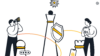
The “Signal” Case: Why True IT Security Must Address Both Technology and People
Although the messaging service Signal is considered particularly secure, attackers were still able to successfully access data—not by cracking the technology, but by exploiting human interaction. Modern cybersecurity is based on two crucial factors: strong technical protection and proper human behavior. The recent attack involving the Signal messenger service clearly demonstrates why the two are inextricably linked. We describe the current incident and what it means for modern businesses.

What happened?
In recent months, numerous high-profile figures from politics, the military, and the media have been targeted via Signal. This was not a traditional cyberattack, but rather a sophisticated phishing campaign.
The attackers proceeded strategically:
- They posed as official support (e.g., “Signal Support”)
- They asked victims to enter login credentials, PINs, or scan QR codes
- They specifically exploited trust and time pressure
As soon as victims responded, the attackers were able to access chats, contacts, and sensitive information.
Important:
- The problem was users’ lack of attention and careless actions, which allowed attackers to exploit legitimate features—combined with social engineering.
- Signal’s own security mechanisms were not compromised.
Social engineering: the targeted manipulation of people to obtain confidential information or trigger specific actions. Unlike traditional cyberattacks, the focus here is not on technology, but on user behavior. Attackers use psychological tactics such as trust, authority, fear, or time pressure to achieve their goals—for example, through purported support requests or urgent security alerts. Precisely because these attacks often appear deceptively genuine and take place through familiar communication channels, they are difficult to detect.

The technical security factor: A foundation, but not enough
Even if the attack was not due to a vulnerability in the software, it underscores all the more how important a well-designed technical security architecture is.
Modern IT security today can:
- implement the “Zero Trust” principle
- secure devices and identities
- systematically reduce attack surfaces
- detect suspicious access attempts
- analyze unusual behavior
It is precisely through the interplay of endpoint management, identity and access management, and security monitoring that many risks can be identified, contained, and mitigated at an early stage. Technology does not prevent every attack—but it limits risk and damage and provides control.
The Human Factor: The Target of Modern Attacks
This case clearly demonstrates that attackers deliberately bypass technical safeguards by targeting people.
Typical patterns:
- Trust (“I’m from Support”)
- Urgency (“Act now”)
- Habit (messaging apps)
Psychological tricks play a major role in cyberattacks and, unfortunately, are all too often successful. That’s what makes these attacks so effective—and so hard to detect.
For businesses, this means:
Technical security solutions are essential—but they are only fully effective when combined with clear processes and employees who are aware of security issues.

What companies must learn from this
For companies, this incident is a clear wake-up call. After all, the same attack method works not only against politicians—but just as effectively in the business world against all companies.
The most important lesson: IT security is only as strong as its weakest link—and that is often not the technology. Technology serves as a stable foundation upon which secure processes and user behavior are built.
That is why companies should build their security strategy around three equally important pillars:
1. Technology – the foundation
- UEM / Endpoint Security
- Identity & Access Management
- Zero Trust & Conditional Access
- Monitoring & Detection
Ensures control, transparency, and protection
2. Processes – the guardrails
- Clear rules for software use, communication, and data sharing
- Dual-control principle for critical actions
- Defined response processes for incidents
Reduces poor decision-making in daily operations and detects incidents early
3. People – the decisive factor
- Awareness training
- Phishing simulations
- Clear recommendations for action
Helps detect attacks and raises awareness for emergencies
Modern awareness training: Tools like SoSafe rely on realistic phishing simulations and interactive learning formats to help employees experience typical attack patterns firsthand. Instead of relying solely on theory, employees learn to recognize suspicious situations and respond appropriately in a real-world work context. This not only increases vigilance in day-to-day work but also ensures a significantly higher level of security throughout the company in the long term.
Conclusion: Security is a collaborative effort
The Signal attack clearly demonstrates: It’s not enough to invest solely in technology—but it’s certainly impossible to do without it.
Companies need:
- robust technical security solutions
- clear processes
- security-aware employees
Only the synergy of all three areas creates true resilience.
If you want to develop a holistic security strategy—from technical safeguards to user awareness—let’s talk! We look forward to hearing from you.